Paid Ads
Performance Marketing Agency vs Freelancer vs In-House: How to Choose
SC
Sourav Chander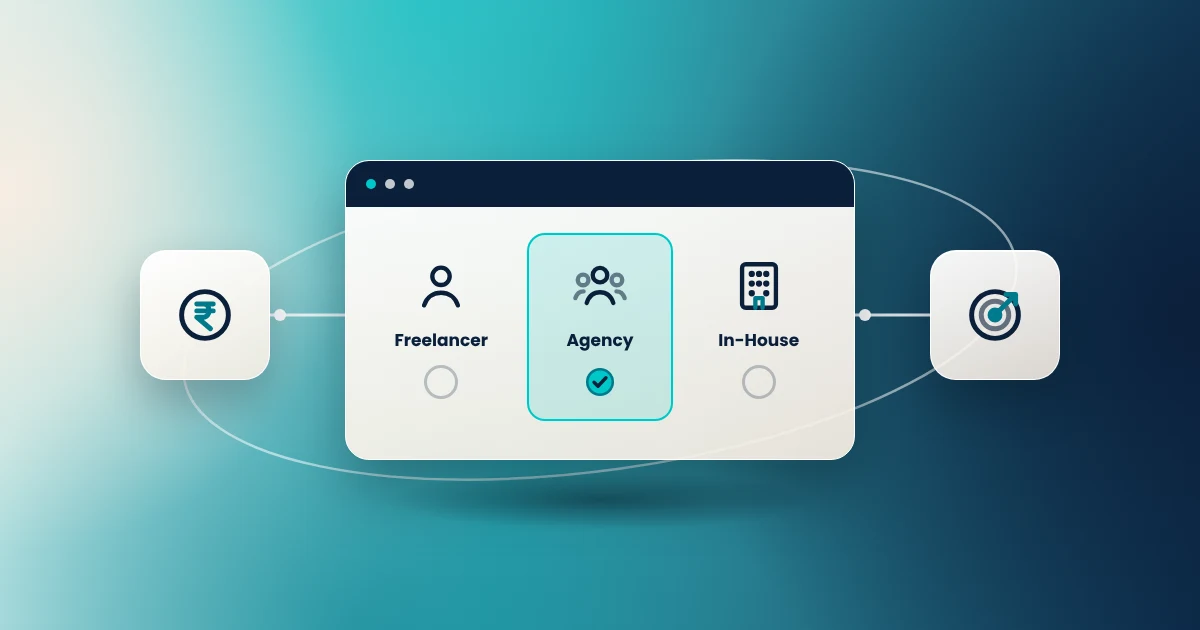
Performance marketing agency, freelancer or in-house team? A decision table by budget and stage, a break-even ROAS calculation and 5 questions to ask.
Should you hire a performance marketing agency, a freelancer or an in-house team?
Here is a situation many founders know: you spend ₹3 lakh (about $3,500) a month on ads, the reports look busy, and sales have not moved in months. You start wondering if the problem is the people running the ads.
The short answer: a freelancer fits small, simple ad accounts; a performance marketing agency fits businesses that need strategy, creative, tracking and landing pages working together; an in-house team fits once ads are a core, steady engine and you can afford two or three specialists. Performance marketing means paid advertising you judge by results, such as leads and sales, not by views. The right choice depends on your budget, your stage and one question most founders skip: who owns the result?
Why is this choice harder in 2027?
Ads cost more, and budgets are not growing to match. WordStream's 2025 Google Ads benchmarks, based on more than 16,000 US campaigns, put the average CPC at $5.26. CPC means cost per click, what you pay each time someone clicks your ad. Cost per click rose for 87% of industries in that study, and the average cost per lead was $70.11.
At the same time, the Gartner 2025 CMO Spend Survey, published on 12 May 2025, found marketing budgets flat at 7.7% of company revenue. In the same survey, 59% of CMOs said they lacked the budget to deliver their strategy, and 39% planned to cut agency budgets.
So every rupee and dollar has to work harder. You cannot afford a setup where nobody owns the full path from ad to sale.
What does each option actually own, and what does it miss?
Most comparisons stop at cost. We think the more useful question is what each option takes responsibility for.
- Usually owns: Freelancer: Campaign setup and daily changes on one or two platforms; Performance marketing agency: Strategy, campaigns, creative, testing and reporting across channels; In-house team: Whatever you hire for, plus deep product knowledge
- Often misses: Freelancer: Creative volume, landing pages, tracking, cover when they are away; Performance marketing agency: Deep product context in the first months; can be slow if poorly managed; In-house team: Range of skills; one person rarely covers ads, creative, tracking and analytics
- Best when: Freelancer: Spend is small and the offer already sells; Performance marketing agency: You need several skills working as one system; In-house team: Ads are a steady core engine and you can hire a team
- Main risk: Freelancer: One person, one point of failure; Performance marketing agency: Paying for activity reports instead of results; In-house team: High fixed cost before you know what works
Look at the "often misses" row. In our experience, results rarely break inside the ad platform alone. They break at the offer, the landing page, the follow up or the tracking. An option that does not own those parts cannot fix them.
Which option fits your budget and stage?
Use this as a starting point, not a rule. It is our point of view after working with startups and SMEs across India, the US, the UK, Canada and Australia.
- Under ₹1 lakh (about $1,200): Stage: Testing if the offer sells; Our usual pick: A good freelancer, or the founder learning with a coach
- ₹1 lakh to ₹10 lakh ($1,200 to $12,000): Stage: Found some traction, ready to grow; Our usual pick: A performance marketing agency that also owns tracking and landing pages
- Over ₹10 lakh ($12,000+): Stage: Ads are a core channel; Our usual pick: An agency plus one in-house owner, or a full in-house team
Two things move you up or down this table. If your sales cycle is long, such as B2B software, you need tracking that connects ads to real deals, which pushes you toward an agency or team. If you sell one simple product online with a proven offer, a strong freelancer can carry you further.
How much does the wrong choice cost you?
Here is a simple calculation you can run on your own numbers. We will use ROAS, which stands for return on ad spend: the revenue you earn for every rupee or dollar spent on ads.
Break-even ROAS = 1 ÷ your profit margin. If you keep 40% of each sale as profit before ad costs, your break-even ROAS is 1 ÷ 0.40 = 2.5. Below 2.5, every sale from ads loses money.
Now picture spending ₹3 lakh a month at a ROAS of 2.0 with that 40% margin.
- Revenue from ads: ₹3 lakh × 2.0 = ₹6 lakh
- Profit before ad costs: ₹6 lakh × 40% = ₹2.4 lakh
- Loss after ad costs: ₹2.4 lakh minus ₹3 lakh = minus ₹60,000 a month
That is ₹7.2 lakh (about $8,500) a year lost, before you pay anyone to manage the account. A cheaper option that keeps you at 2.0 is not cheaper. To check your own numbers, request our Ad Spend Leak Checklist + Break-even ROAS Calculator.
What does a good performance marketing agency do that others skip?
The difference shows up in what gets measured. A weak setup reports clicks and cost per click. A good one connects every ad to real revenue. In our experience, that comes down to three habits:
- Feeding sales data back into the ad platform. When a lead becomes a paying customer, that result is sent from your CRM back into Google Ads or Meta. A CRM is the system where your sales team tracks leads and deals. The platform then learns which kind of lead turns into revenue, not just which kind fills in a form.
- Owning the landing page. Each ad goes to a page built for that offer and that market, and the page is tested every week.
- Reporting one business number. Qualified leads, sales or revenue, every week, with the cost per result next to it.
The lesson is not "agencies always win". It is that the team you hire must own tracking and the path after the click, not just the ads.
What should you ask before you sign anyone?
We call this the Three Owner Test. Ask any freelancer, agency or new hire these questions:
- Who owns the number? Ask which single result they will report on each week: leads, qualified leads, sales or revenue. If the answer is clicks or reach, be careful.
- Who owns the page after the click? Ask whether they will review and change your landing pages and forms, or only the ads.
- Who owns the tracking? Ask how they will prove which ads lead to sales, and what they need from your CRM or sales team.
Then add two practical checks. Ask who will be working on your account each week, by name. And ask what they would stop doing in the first 30 days, because a good partner cuts waste before adding spend.
If you already work with several agencies at once, our guide on managing multiple marketing agencies shows how to keep one strategy across all of them.
What is the next step?
Write down your monthly ad spend, your profit margin and your current ROAS. Run the break-even calculation above. That one number tells you whether you have a people problem or a setup problem.
You can see how we run paid media as one connected system on our Paid Growth Engine page, and what our PPC management service covers. Ask us for the Ad Spend Leak Checklist + Break-even ROAS Calculator to run the numbers yourself. If you want a second opinion on your current setup, book a free Growth Consultation and we will walk through your numbers with you.
Frequently asked questions
Is a performance marketing agency better than a freelancer?
Not always. A freelancer can be the better choice when your spend is small and your offer already sells. An agency makes more sense when you need strategy, creative, landing pages and tracking handled together.
When should I build an in-house performance marketing team?
Usually when ads are a steady core channel and you can afford two or three specialists, not one person doing everything. Many businesses keep an agency for range and hire one in-house owner to manage it.
What should a performance marketing agency report every week?
One business result, such as qualified leads, sales or revenue, plus cost per result. Clicks and impressions are useful inside the team, but they should not be the headline of your report.
How do I know if my ads are losing money?
Work out your break-even ROAS: 1 divided by your profit margin. If your actual ROAS is below that number, each sale from ads costs more than it earns.
Book a Growth Consultation
Talk to our team about where your growth is stuck and what to fix first.
Book a Growth Consultation