Paid Media
ChatGPT Ads vs Google Ads: Where Should Your Money Go?
UE
Uptrix Editorial Team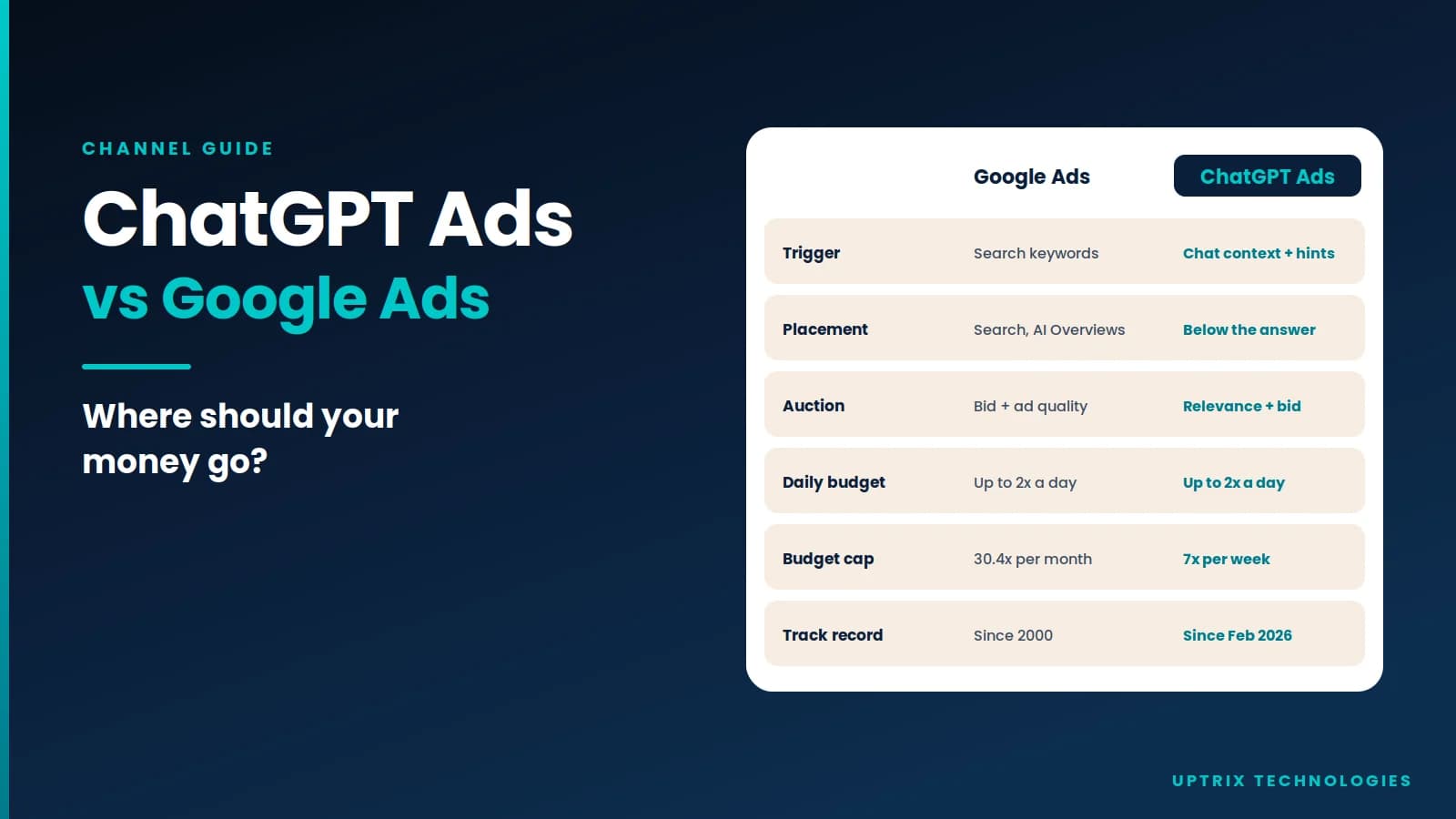
Compare ChatGPT ads and Google Ads on targeting, AI placements, budgets, measurement and category rules, and see where your ad budget should go.
- •Google Ads triggers on search keywords. ChatGPT ads trigger on conversation context.
- •Google now shows ads in and around AI Overviews too.
- •Both platforms let a day's spend reach twice the daily budget.
- •Google caps a month at 30.4 times the daily budget. OpenAI caps a week at seven times.
- •ChatGPT restricts finance, health and legal ads outside the US.
- •Keep Google as the base and test ChatGPT alongside it.
Key Insight
For most businesses in 2026, Google Ads should still get the bigger share of paid search money, and ChatGPT ads should get a small, capped test. Google has decades of targeting and reporting behind it. ChatGPT ads reach people mid-decision inside a conversation, but the platform launched in February 2026 and restricts more categories. The two work best side by side, not as a swap.
The problem
Founders keep asking the same question: "Should I move some of my Google budget to ChatGPT?" It's a fair question. More people now research purchases by chatting with AI. But moving money out of a channel that works, into one that's months old, is risky if you don't know how the two differ.
This guide compares them on the things that decide where budget should go, using each platform's own documentation.
The short answer
Don't swap. Stack.
Keep Google Ads as your main paid search channel if it already brings you customers at a cost you understand. Add ChatGPT ads as a small test with a fixed cap, but only if your category is allowed and your conversion tracking works. Move more money only when ChatGPT's cost per lead or sale matches or beats Google's.
New to ChatGPT ads? Start with our main guide: ChatGPT Ads: How They Work and Whether Your Business Should Try Them.
How do ChatGPT ads and Google Ads compare?
| Google Ads (Search) | ChatGPT Ads | |
|---|---|---|
| What triggers the ad | Search keywords, plus broader AI matching options | Conversation context, guided by your context hints |
| Where the ad appears | Google search results, including above, below and within AI Overviews | Below ChatGPT's answer |
| How the winner is chosen | An auction on each search | A relevance-weighted, second-price auction |
| Ways to pay | Mainly per click, with automated bidding options | Per 1,000 views, per click, or conversion-optimised versions of both |
| Daily budget behaviour | Up to 2x the average daily budget on one day | Up to 2x the daily budget on one day |
| Overall cap | 30.4x the daily budget per month (most campaigns) | 7x the daily budget per week |
| Regulated categories | Governed by Google's own ad policies | Finance, health and legal generally not allowed outside the US |
| Track record | Launched as Google AdWords in 2000 | Ads began in February 2026 |
How is targeting different?
The biggest difference is what starts the auction.
On Google, the search query is the core signal. You choose keywords, and Google matches them to searches. Google's newer options, like broad match and AI Max for Search, widen that matching.
On ChatGPT, there are no exact-match keywords. OpenAI's Help Center says you write context hints, which describe the conversations and topics where your ad may be relevant. It says these guide matching but aren't exact-match keywords and don't guarantee delivery. OpenAI also looks at your landing page, headline and copy, plus location, platform and custom audience settings.
What this means: Google gives you more direct control over when your ad appears. ChatGPT rewards clear, relevant ads and pages, because relevance is built into how the winner is picked.
Isn't Google also putting ads into AI answers?
Yes, and this matters for the comparison.
Google's Ads Help Center says ads can appear above or below AI Overviews in all markets where AI Overviews are available. Ads within AI Overviews are currently available in English in 12 countries, including India and the US.
There are limits. Google says you can't target AI Overview placements directly, can't opt out, and don't get separate reporting for them. It also doesn't show ads within AI Overviews for sensitive categories like finance, healthcare and politics.
So "AI search advertising" isn't only a ChatGPT story. Your Google campaigns may already be reaching people in AI-style answers, especially if you use broad match, AI Max, Performance Max or Shopping campaigns, which Google says are needed to match ads in AI Overviews.
How do budgets compare?
The two platforms handle daily budgets in a similar way, with one key difference.
Both treat your daily budget as an average. Google's Help Center says a campaign can spend up to twice its average daily budget on a single day. OpenAI's Help Center says the same for ChatGPT ads.
The difference is the cap:
- Google limits most campaigns to 30.4 times the average daily budget in a month.
- ChatGPT limits spend to seven times the daily budget over a seven-day period.
Minimum budgets also differ. OpenAI sets minimum daily budgets by market, such as $25 in the US. For full ChatGPT pricing details, read ChatGPT Ads Pricing and Bidding Explained.
Which is easier to measure?
Google, for now.
Google Ads has run conversion tracking and reporting for many years, and most businesses already have it connected. ChatGPT ads report impressions, clicks, spend, click-through rate, average costs and conversions, using OpenAI's pixel and Conversions API. That's enough to run a fair test, but the tools are newer.
One point cuts both ways: Google's Help Center says it doesn't give separate reporting for ads shown within AI Overviews. So on neither platform can you fully isolate "AI answer" performance today.
Which businesses should favour which channel?
| Your situation | Where the money should go |
|---|---|
| You're in finance, health or legal services outside the US | Google Ads. ChatGPT generally doesn't allow these categories there yet |
| Google Ads already brings customers at a good cost | Keep Google as the base. Test ChatGPT with a small, capped budget |
| Google Ads isn't working yet | Fix Google first with a PPC review. A new channel won't fix weak tracking or pages |
| You sell considered purchases in allowed categories (consumer goods, travel, education, digital products, local services) | A strong case for a ChatGPT test alongside Google |
| You can't track conversions yet | Neither. Set up tracking before spending on either |
What Uptrix Technologies believes about this
We don't think this is an either/or decision. Google Ads is where proven demand already sits. ChatGPT ads are where a growing share of research conversations happen.
Our view: protect what works, then test what's next, inside one growth plan rather than as a separate experiment. Using the Uptrix 5S™ framework, that means a Scan of your current Google performance first, so any ChatGPT test has a real benchmark to beat. Without that benchmark, you can't tell whether the new channel is winning.
Conclusion
Google Ads and ChatGPT ads reach people at similar moments of research, but they differ in targeting, category rules and maturity. For most businesses, Google stays the base, and ChatGPT earns budget by beating it in a fair, tracked test.
For the full picture, read ChatGPT Ads: How They Work and Whether Your Business Should Try Them. If you're in India, also see our guide to ChatGPT ads in India.
Not sure how to split your budget?
Uptrix Technologies is a growth marketing company. One team owns strategy, execution and performance, from the first strategy call to scale. Book a growth consultation and we'll look at your Google results before you test ChatGPT ads.