Paid Media
ChatGPT Ads: How They Work and Whether Your Business Should Try Them
UE
Uptrix Editorial Team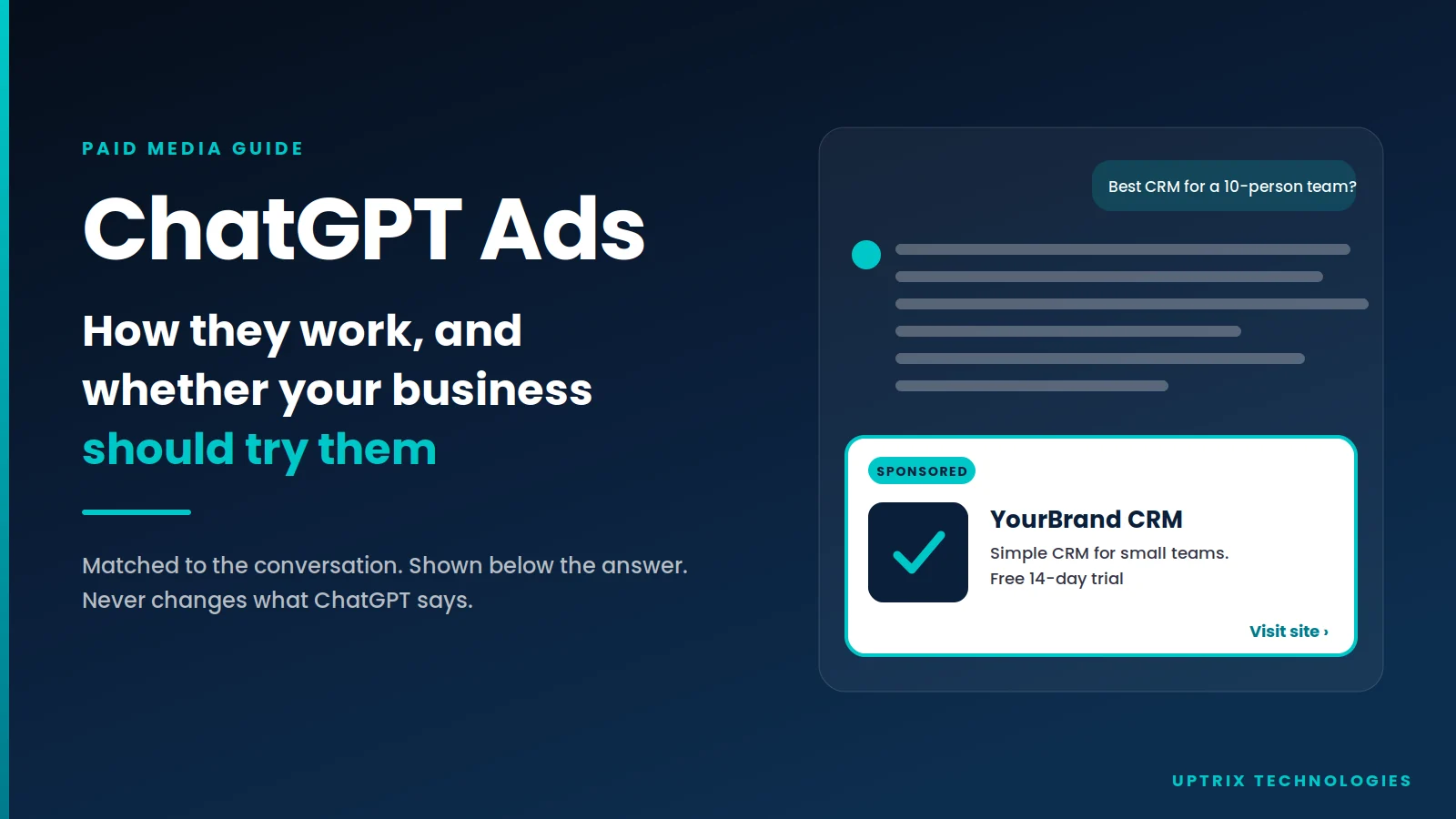
Learn how ChatGPT ads work, who sees them, how to buy them, what they cost and how to track results, plus a clear test to decide if they suit your business.
- •ChatGPT ads are clearly labelled sponsored listings shown below ChatGPT's answer.
- •They are matched to what the user is talking about, not to keywords you pick.
- •They appear for users on the Free and Go plans. Paid Plus, Pro and business plans are ad-free.
- •You can buy on a cost per click or cost per thousand views basis.
- •Advertisers never see user chats. You get combined performance data only.
- •Test with a small budget once your tracking and landing pages are ready.
Key Insight
ChatGPT now shows paid ads to free users in a growing list of countries, and any business can buy them through a self-serve Ads Manager. The ads appear below ChatGPT's answer, are matched to the topic of the conversation, and never change what ChatGPT says. For most startups and SMEs, the right move in 2026 is a small, measured test, not a budget shift.
The problem: a new ad channel, and a lot of noise
Every new ad platform brings two messages at once: "get in early" and "it's hype, ignore it." ChatGPT ads are no different. Founders are asking whether to move money out of Google or Meta, and most of what is written is either a press release summary or a sales pitch.
This guide explains how ChatGPT ads work in plain English, using OpenAI's own announcements, and gives you a clear way to decide whether they suit your business right now.
The short answer
ChatGPT ads are paid listings that OpenAI shows inside ChatGPT conversations. When someone asks ChatGPT about a topic linked to buying something, such as meal kits, software, or home repairs, ChatGPT gives its normal answer. Below it, a labelled "Sponsored" ad from a relevant business may appear.
Businesses create these ads in OpenAI's Ads Manager or through partners, set a budget, and pay per click or per thousand views. OpenAI decides which ad to show based on relevance to the conversation. The ad does not change ChatGPT's answer, and the advertiser never sees the chat.
For most growing businesses, ChatGPT ads are worth a small, tracked test in 2026. They are not yet a reason to cut spend on channels that already bring you customers.
What are ChatGPT ads?
ChatGPT ads are sponsored placements inside ChatGPT, OpenAI's AI assistant. OpenAI started testing them in the US on 9 February 2026 and says they help pay for free access.
Three rules shape how the ads behave, based on OpenAI's published principles:
- Answers stay independent. An ad never changes what ChatGPT tells the user.
- Conversations stay private. Advertisers do not see chats, chat history, memories, or personal details.
- Users stay in control. People can hide ads, see why an ad was shown, delete their ad data, and turn off ad personalisation.
In practice, a ChatGPT ad is a small card below the answer with a business name, headline, link, and sometimes an image or price.
How do ChatGPT ads work?
ChatGPT ads work by matching your ad to the context of a user's conversation. You don't bid on search keywords the way you do in Google Ads (Google's search advertising platform). OpenAI's platform reads the conversation and decides which ad fits.
According to OpenAI's Help Center, the choice of ad draws on these signals:
- The current conversation. If someone is planning recipes, they might see ads for grocery delivery.
- Your ad and landing page. The title, copy and page you link to all count.
- Your settings. Context hints (short descriptions you write about when your ad is relevant) and the targeting you choose, such as location, platform and custom audiences (lists of people you already know, like past customers).
- The user's wider ChatGPT use. Only where ad personalisation is switched on: past chats, memory, and which ads they clicked or hid.
If several ads qualify, OpenAI weighs relevance together with advertiser bids to decide which to show first. OpenAI makes all delivery decisions, even when a partner helps you buy.
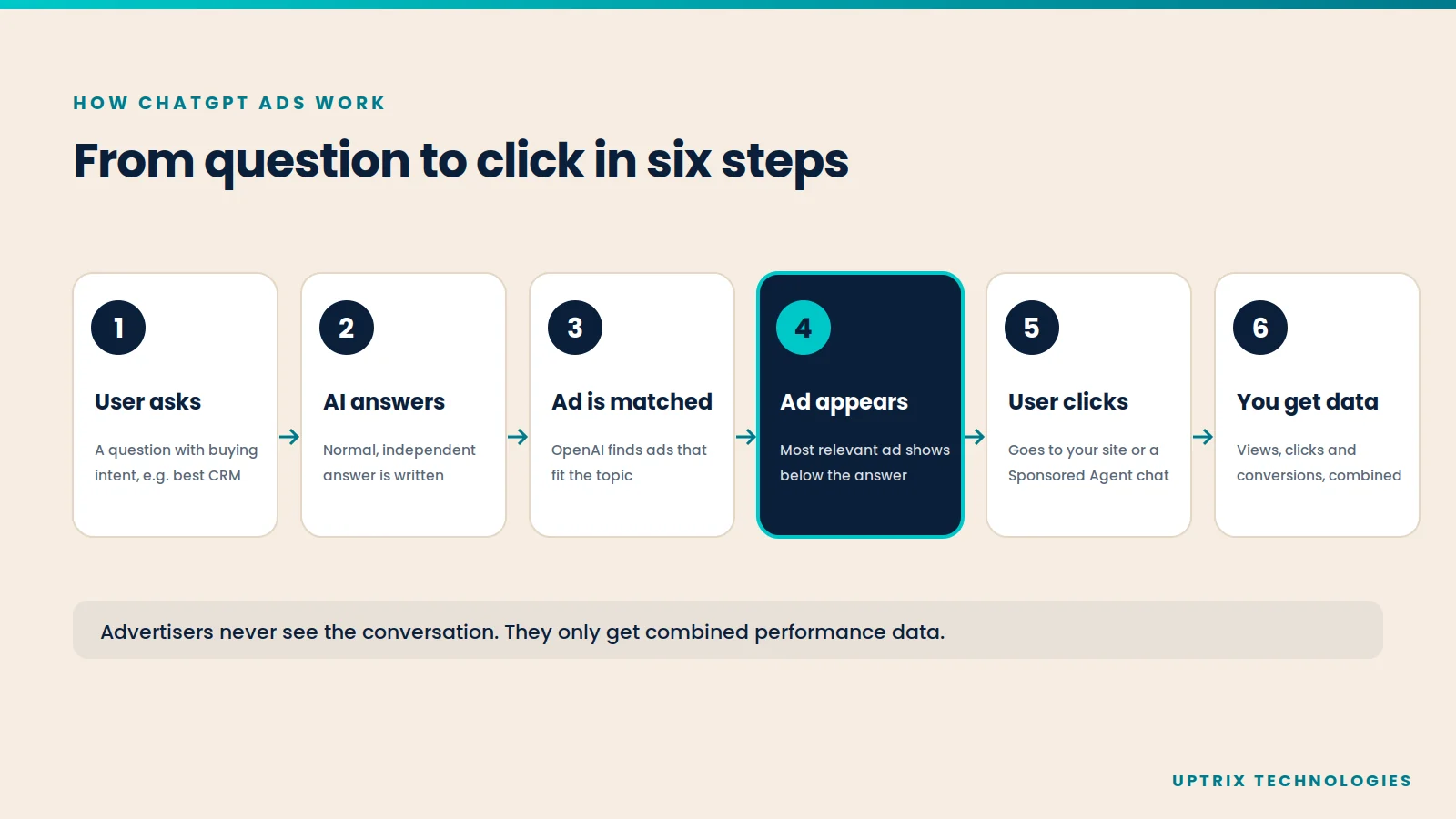
Here is the flow in simple steps:
- A user asks ChatGPT a question with buying intent, for example "What's a good project management tool for a 10-person team?"
- ChatGPT writes its normal, independent answer.
- OpenAI checks which active ad campaigns fit the topic.
- One or more matching ads appear below the answer, labelled "Sponsored."
- If the user clicks, they go to your website (or, in a new test, into a conversation with your business's own AI agent).
- You see combined results such as views, clicks, and conversions in Ads Manager.
The important shift: on search engines, you bid on the words people type. On ChatGPT, you compete on how well your ad fits what people are trying to do.
Who sees ChatGPT ads, and who doesn't?
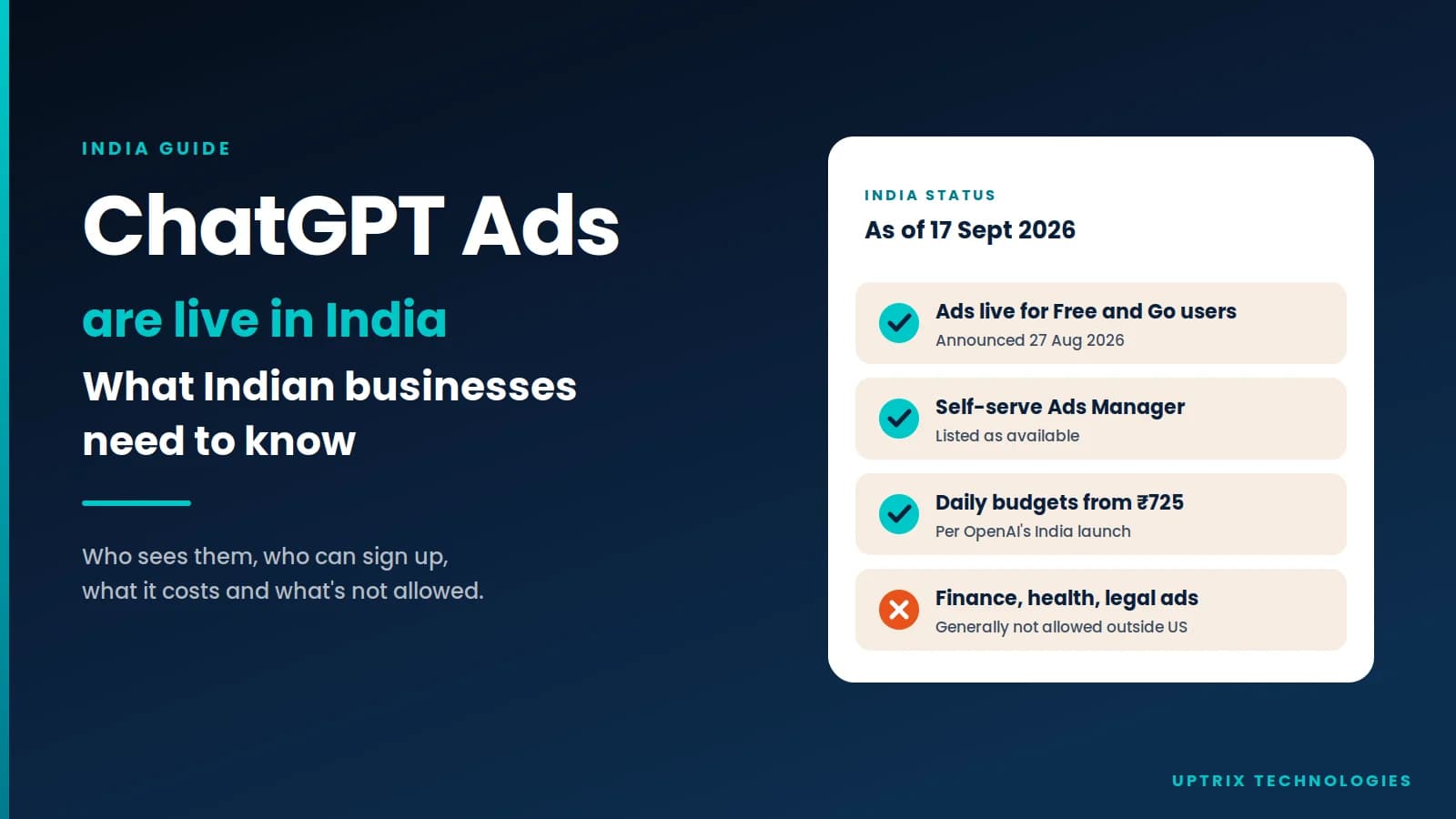
ChatGPT ads can appear for users on the Free and Go plans. ChatGPT Go is OpenAI's low-cost paid plan. OpenAI's Help Center adds that any ads shown to logged-out users are limited to ones suitable for all audiences.
Based on OpenAI's announcement, these groups do not see ads:
- Plus, Pro, Business, Enterprise, and Education subscribers
- Users who tell OpenAI they are under 18, or whom OpenAI predicts are under 18
- Free users who switch to the Ads-Free option, which comes with fewer messages and fewer tools
- Anyone using a Temporary Chat
OpenAI also says ads do not appear next to sensitive conversations, such as personal health, mental health, or politics.
What this means for you: your audience is the large free and low-cost user base. Many professional and enterprise users pay for ChatGPT and will not see your ads. If you sell mainly to large companies whose teams use ChatGPT Enterprise, this channel reaches fewer of your buyers than the headline numbers suggest.
Where are ChatGPT ads available right now?
ChatGPT ads have rolled out market by market through 2026. Here is the timeline from OpenAI's own updates:
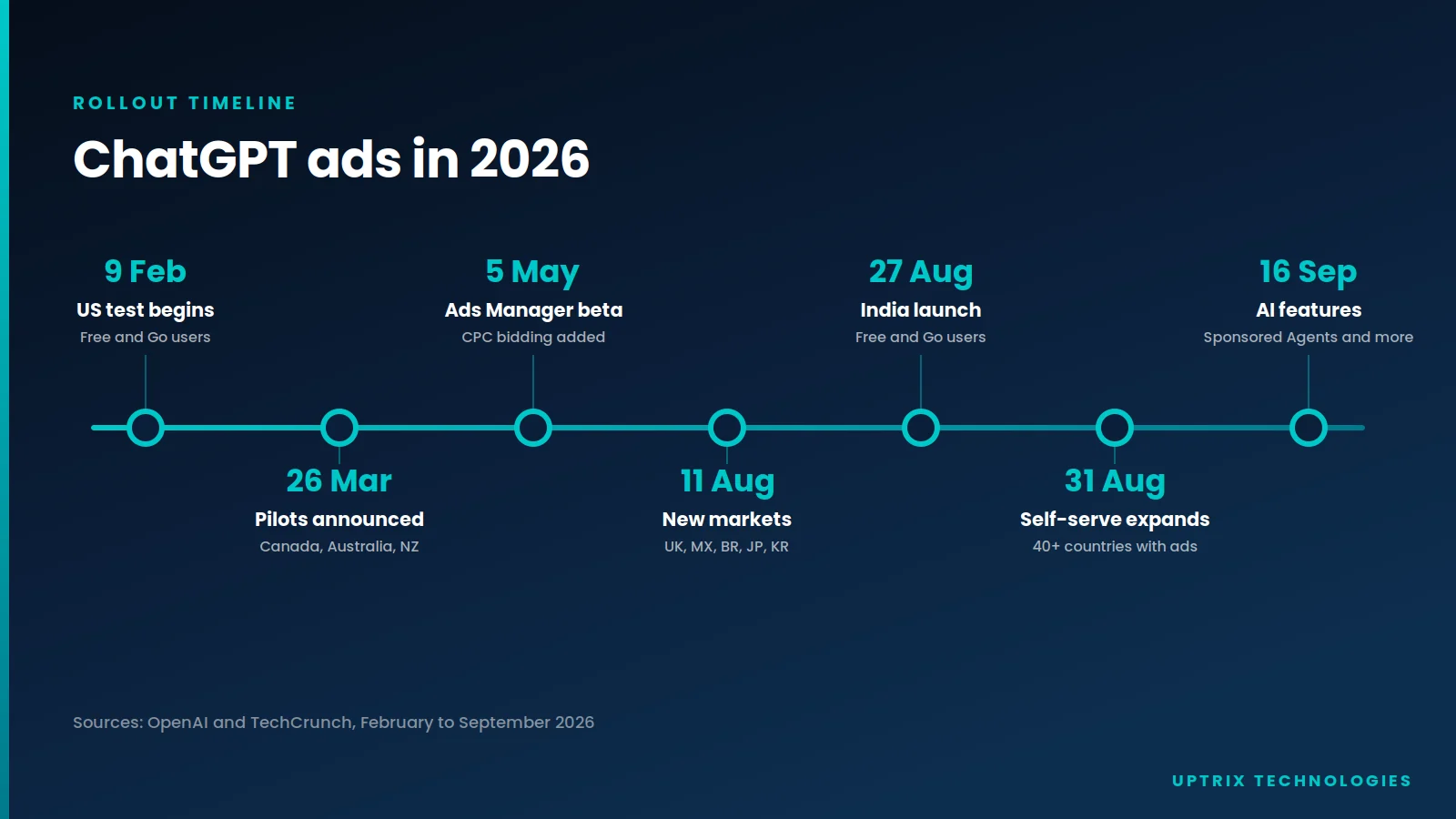
| Date (2026) | What happened |
|---|---|
| 9 February | Ads test begins in the United States for Free and Go users |
| 26 March | OpenAI announces pilots in Canada, Australia, and New Zealand |
| 5 May | Beta self-serve Ads Manager and CPC bidding launch |
| 11 August | Ads launch in the UK, Mexico, Brazil, Japan, and South Korea |
| 27 August | Ads begin in India for Free and Go users, with WPP and Omnicom as first agency partners |
| 31 August | OpenAI announces self-serve buying for India, Europe, the Middle East, and North Africa, and says ads are available in over 40 countries |
| 16 September | Sponsored Agents test, AI creative tools, HubSpot and Shopify integrations announced |
OpenAI says it plans to keep expanding to more markets. Availability changes quickly, so check ads.openai.com for the current list before planning a campaign.
Advertising in India? OpenAI's Help Center now lists India as available for self-serve buying. We cover what Indian businesses need to know in a separate guide: Are ChatGPT Ads Available in India? What Indian Businesses Need to Know.
How do you buy ChatGPT ads?
There are four ways to buy ChatGPT ads, based on OpenAI's announcements.
1. The self-serve Ads Manager. Launched in beta on 5 May 2026. You register as an advertiser, add payment details, set budgets and bids, upload ads, and track results in one dashboard. OpenAI says it is built for businesses of all sizes, from startups to global brands.
2. Through partners. OpenAI works with large media groups including Dentsu, Omnicom, Publicis, and WPP, plus technology partners such as Adobe, Criteo, Kargo, Pacvue, and StackAdapt.
3. Through HubSpot. Announced 16 September 2026. Businesses using HubSpot (a customer relationship management, or CRM, tool) can create ChatGPT ads, track results, and follow up on leads inside HubSpot.
4. Through Shopify. Also announced 16 September 2026. US Shopify stores can use the ChatGPT Ads app to connect their product catalogue. OpenAI says the app launches in other ChatGPT Ads markets on 23 September 2026.
To start, you sign up at ads.openai.com. Our step-by-step setup guide walks through every screen.
Not sure your ad accounts and tracking are ready for a new channel? Talk to a growth strategist at Uptrix Technologies before you spend your first rupee or dollar on ChatGPT ads.
How much do ChatGPT ads cost?
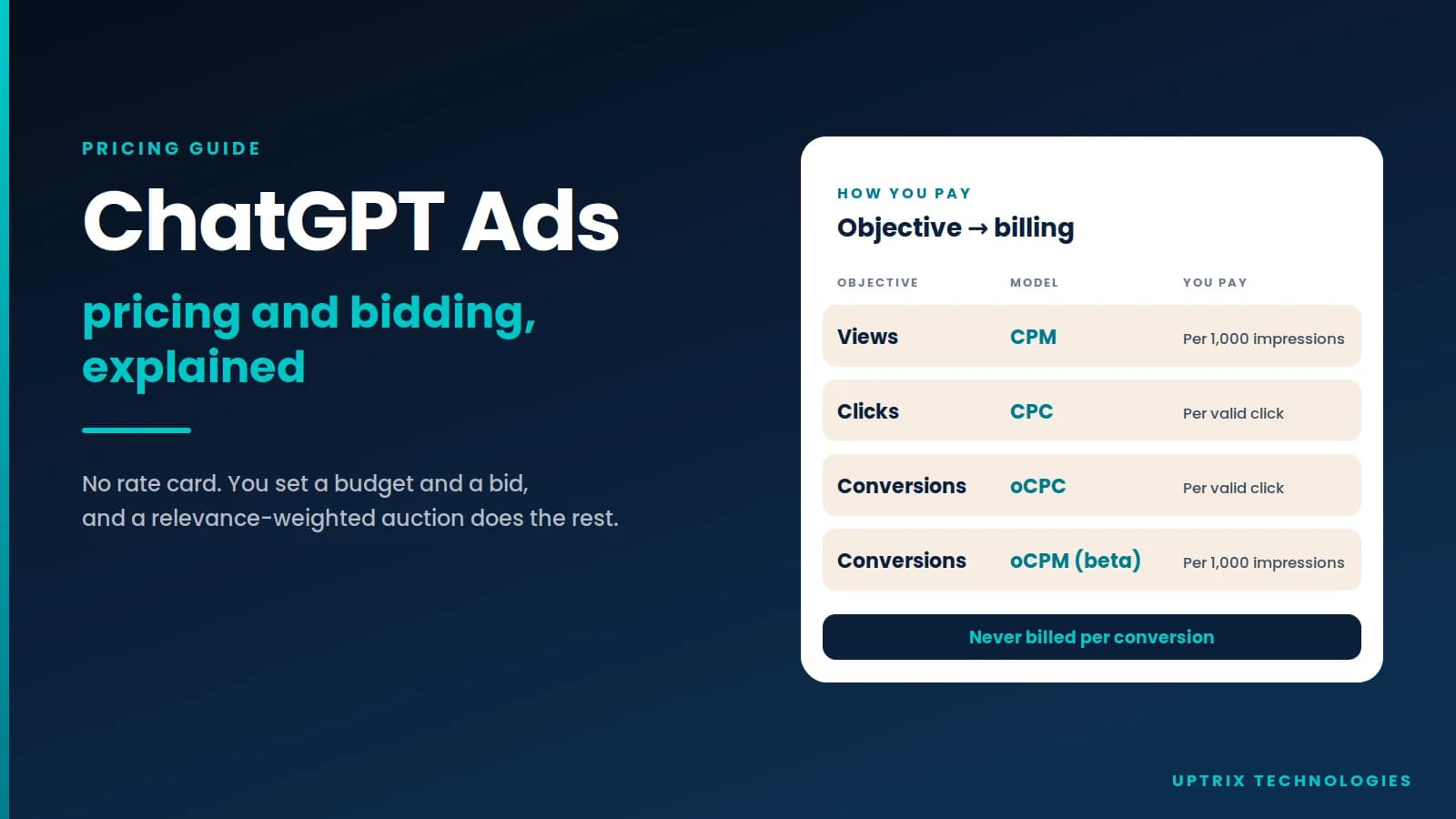
ChatGPT ads have no fixed price. You set a budget and a bid, and OpenAI's Help Center lists three ways to buy:
- CPM (cost per mille): you pay for every 1,000 times your ad is shown. This was the only option in the early pilot.
- CPC (cost per click): you pay only when someone clicks your ad. OpenAI added this on 5 May 2026.
- Conversion-optimised: the platform aims for an action you choose, such as a purchase or lead. You are still billed per click or per 1,000 views, not per conversion, and not every advertiser is eligible.
The minimum daily budget varies by market and currency. OpenAI's Help Center gives the US minimum as $25 a day. A daily budget works as an average over seven days, so a single day can spend up to twice your daily amount, but a week never goes above seven times it.
OpenAI doesn't publish a rate card. Its Help Center recommends starting click campaigns with a maximum bid of $3 to $5 per click, and the final price is set by a relevance-weighted auction. We break down bidding and budgeting in detail in ChatGPT Ads Pricing and Bidding Explained.
A practical rule: decide your test budget based on what a new customer is worth to you, not on what the platform suggests. If you don't know your customer value yet, fix that before testing any new channel.
How do you track results from ChatGPT ads?
You track ChatGPT ad results through OpenAI's pixel and Conversions API.
- A pixel is a small piece of code on your website that records actions, such as a purchase or form fill, after someone clicks your ad.
- A Conversions API sends those same actions from your server to OpenAI. It is more reliable than a pixel alone because browser blockers don't stop it.
You get combined data such as views, clicks, and conversions, never individual users or chats. OpenAI also says better conversion signals help it show more relevant ads, so weak tracking hurts both reporting and results.
What's new: Sponsored Agents and AI creative tools
On 16 September 2026, OpenAI announced several new features:
- Sponsored Agents (testing in the US with select advertisers). After clicking an ad, a user can start a labelled conversation with an AI agent set up by the business. They can ask questions and then go to the website. This conversation is kept separate from ChatGPT's own answers. The business sees only the messages the user sends to its agent.
- Ads Manager plugin in ChatGPT. Create, update, and review campaigns by typing simple instructions.
- AI creative help. Suggested copy and images based on your landing page. You approve everything.
- Optional text customisation. If switched on, your ad text is adapted to each conversation and translated into the user's language.
What can't you advertise on ChatGPT?
OpenAI's ad policies (updated September 2026) say that, for now, ads are mainly limited to consumer categories: household and consumer goods, local services, travel and entertainment, and digital products and education.
Other categories are restricted or not allowed:
- Not allowed: political ads, gambling, alcohol and tobacco, adult content, recreational drugs, and individual job or property listings.
- US only, case by case: financial services, health services and legal services. OpenAI says these are generally prohibited outside the US.
- Limited: wellness products may run only if they make no unproven health claims.
Ads also never appear next to sensitive conversations, such as personal health, mental health, or politics. Every ad, including its landing page, is reviewed before it can run.
If your business is anywhere near a restricted category, read OpenAI's ad policies before planning a campaign, and check our guide to ChatGPT ads in India if you're an Indian business.
How are ChatGPT ads different from Google Ads and Meta Ads?
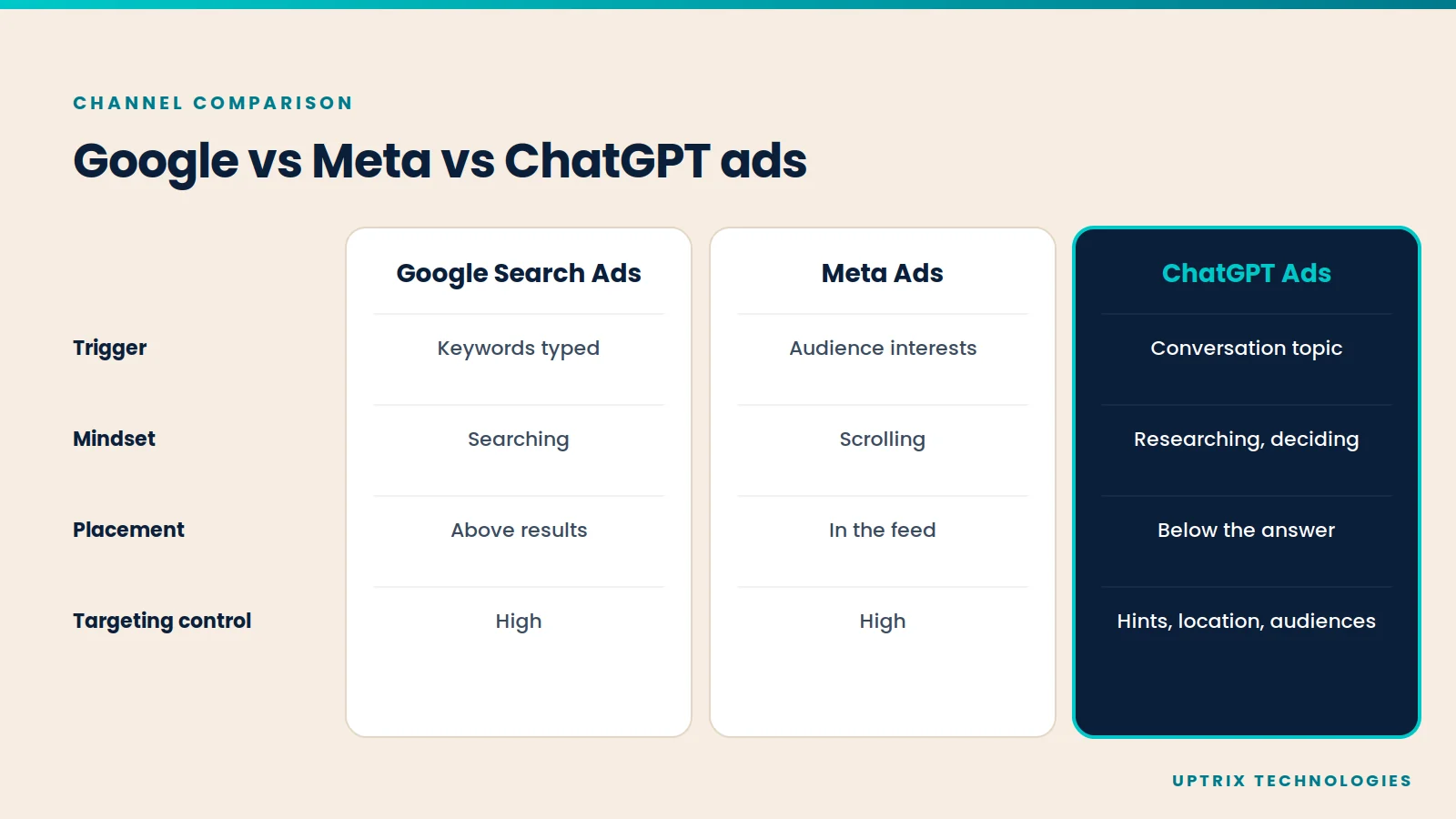
| Google Search Ads | Meta Ads | ChatGPT Ads | |
|---|---|---|---|
| What triggers the ad | Keywords the user types | Audience profile and interests | Topic of the conversation |
| User mindset | Searching for something | Scrolling for entertainment | Researching or deciding |
| Where the ad sits | Above or beside search results | Inside the feed or stories | Below ChatGPT's answer |
| Targeting control | High | High | Growing: context hints, location, platform, custom audiences |
| Maturity | Over 20 years | Over 10 years | Launched in 2026 |
| Measurement | Mature | Mature | New and still growing |
The biggest difference is how you steer delivery. On ChatGPT, you guide the platform with context hints, location, platform and audience choices, but it makes the final match based on the conversation. That rewards clear offers and useful pages more than clever keyword lists.
We compare the three in depth in ChatGPT Ads vs Google Ads: Where Should Your Money Go?.
Should your business try ChatGPT ads?
ChatGPT ads are a good fit if most of these are true:
- You sell in an allowed category. Consumer goods, local services, travel, digital products, or education.
- People research before buying from you. Considered purchases fit better than impulse buys.
- Your buyers are likely on Free or Go plans. Teams on paid business plans won't see ads.
- You are in an available market. Check OpenAI's Help Center for the current list.
- Your tracking works. You can see which clicks turn into leads or sales.
- Your landing pages answer questions clearly. ChatGPT users arrive mid-research and expect straight answers.
- Your core channels are stable. Google, Meta, or SEO already bring you customers at a cost you understand.
Wait for now if:
- You are in a restricted category, such as finance, health, legal services or politics. Outside the US, most of these can't advertise at all right now.
- You can't yet measure cost per lead or cost per sale on your existing ads.
- Your ad budget is already stretched across too many channels. (Our piece on who owns growth when execution is split across agencies explains why that hurts.)
How do you get ready for ChatGPT ads?
At Uptrix Technologies, we plan any new channel through the Uptrix 5S™ framework: Scan → Strategy → Sequence → Ship → Scale. Here is how it applies to ChatGPT ads.
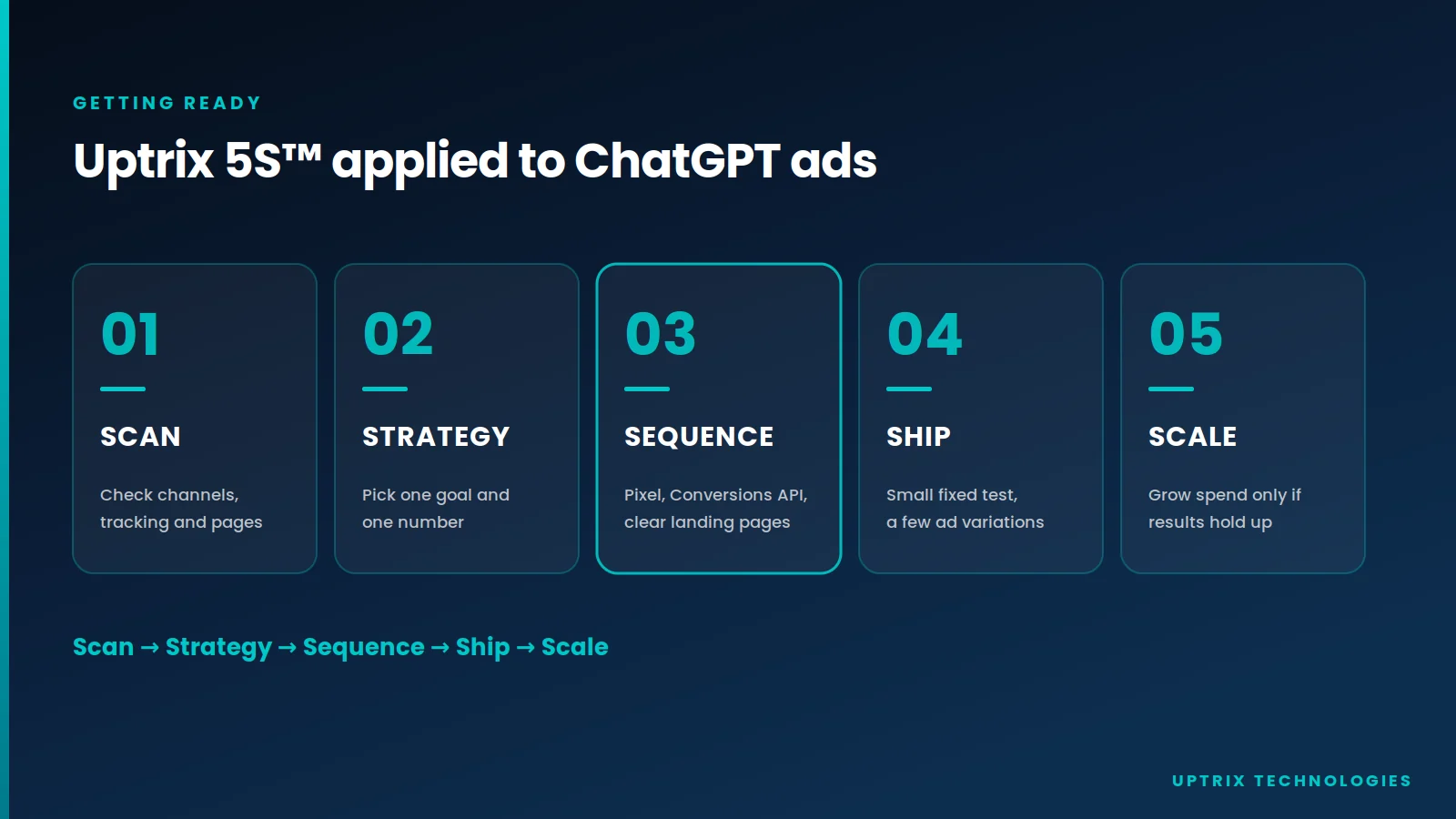
Scan. Check your channels, tracking, and pages. Know what a customer costs you today on Google or Meta.
Strategy. Pick one goal (leads, sales, or a new market) and one number to judge it by.
Sequence. Set up the pixel and Conversions API, and make sure your landing page answers buyers' questions. Then launch.
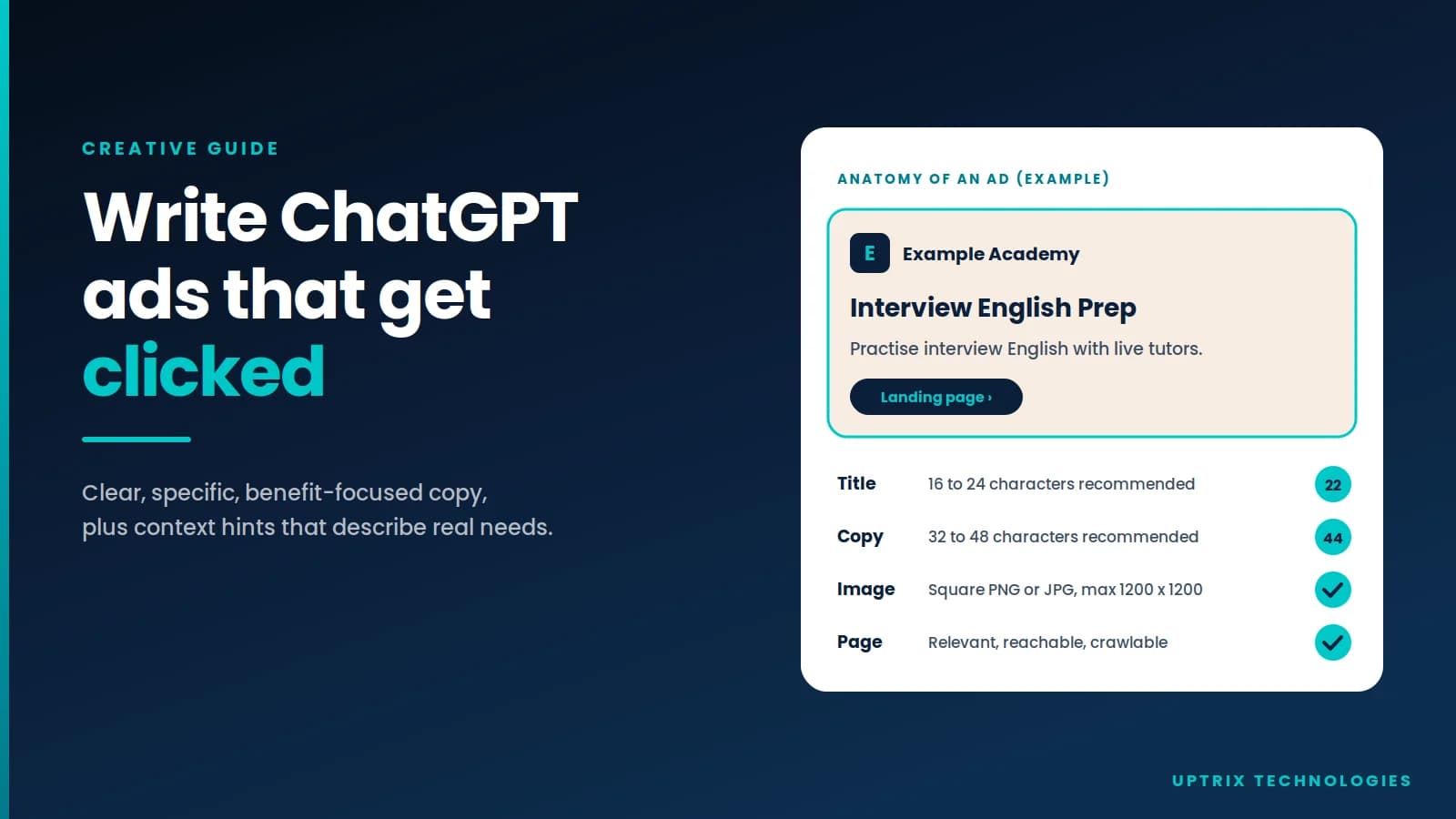
Ship. Start with a small, fixed budget and a few ad variations (here's how to write them), and run it long enough to get real data.
Scale. Increase spend only if the results beat or match your existing channels on cost per lead or cost per sale.
You can read more about how the framework works on the Uptrix 5S™ framework page.
Want a second opinion before you test? Our paid media team can check whether your tracking, pages, and budget are ready for ChatGPT ads.
The case against rushing in
The platform is still changing fast. In seven months, OpenAI went from a small US test to self-serve buying in over 40 countries. Rules you plan around today may change next quarter.
Measurement is young. ChatGPT's pixel and Conversions API are new, so early data may be thin or hard to compare.
Control works differently. You can't bid on exact keywords, and the platform makes the final match. For some businesses, that means less predictable results.
Early buzz is not proof. OpenAI reported on 31 August 2026 that ChatGPT Ads hit a $1 billion annualised revenue run rate in under 200 days. That shows advertiser demand, not that any single business will profit.
These are reasons to test carefully, not to ignore the channel.
What Uptrix Technologies believes about this
We believe ChatGPT ads are a real channel, not a fad, because they reach people while they compare options and decide.
We also believe most businesses should earn their way in. A new channel doesn't fix weak tracking, unclear offers, or pages that don't answer buyers' questions. It only makes those gaps more expensive.
So get your foundations right, run a small tracked test with one clear goal, and let the numbers decide whether ChatGPT ads deserve more budget.
And whether you advertise or not, make sure your business shows up well in ChatGPT's organic answers. Our AI SEO services focus on exactly that.
Conclusion
ChatGPT ads put your business in front of people while they research and decide. The opportunity is real, but the platform is young. The businesses that benefit most will arrive with working tracking, clear landing pages, and a disciplined test plan.
If you're weighing where ChatGPT ads fit alongside your current marketing, start with a plan, not a campaign. Our startup marketing strategy guide explains how to build one growth plan before adding more channels.
Ready to decide whether ChatGPT ads are right for you?
Uptrix Technologies is a growth marketing company. One team owns strategy, execution and performance, from the first strategy call to scale.
Book a growth consultation and we'll help you work out whether ChatGPT ads belong in your plan, and what to fix before you spend.
Frequently asked questions
How do ads on ChatGPT work?
ChatGPT ads are matched to the topic of a user's conversation. ChatGPT gives its normal answer, and a relevant, labelled sponsored ad may appear below it. The ad does not change the answer.
Can any business advertise on ChatGPT?
Businesses in available markets can sign up through the self-serve Ads Manager at ads.openai.com, or buy through partners, HubSpot, or Shopify. OpenAI reviews every advertiser and ad, bans political ads, and restricts categories such as finance and health.
Do ChatGPT ads change ChatGPT's answers?
No. OpenAI says ads do not influence ChatGPT's answers and are always shown separately and labelled as sponsored.
Can advertisers see my ChatGPT conversations?
No. OpenAI says advertisers cannot see chats, chat history, memories, or personal details. They only receive combined data such as views and clicks.
Are ChatGPT ads better than Google Ads?
Not yet for most businesses. Google Ads has mature targeting and measurement. ChatGPT ads are worth testing alongside Google, not instead of it, once your tracking is in place.